
Start with a full body compound based beginner strength program run three times a week, adding weight every session until it stops moving. This linear progression model works because it combines progressive overload with enough frequency and recovery time to let a novice's nervous system adapt fast. Pick one template below, load the bar light, and begin this week.
TL;DR:
- The linear progression model for beginners emphasizes adding weight after every successful session, with small increments to avoid early stalls.
- The 5x5 barbell template is the simplest and most popular, but beginners with slow recovery may prefer a Starting Strength-style split or home routines using body weight.
- Progress stall signals include failing to complete all reps twice in a row, which requires a deload or examining recovery factors like sleep and diet.
- The five key exercises—squat, hinge, press, pull, and row—cover most beginner strength gains, and substitutions can maintain training effectiveness.
- Consistent training with good form, proper nutrition, and adequate sleep remains more important than complex programming or advanced techniques.
Table of Contents
- What is the best beginner strength program?
- How do you know when to add weight or deload?
- Which exercises matter most for a beginner?
- How should you structure your training week?
- What should you eat and how much should you sleep?
- Do you need medical clearance before starting?
- Why simplicity beats complexity for new lifters
- AadiFit: build your beginner program around real feedback, not guesswork
- Sources
- FAQ
What is the best beginner strength program?
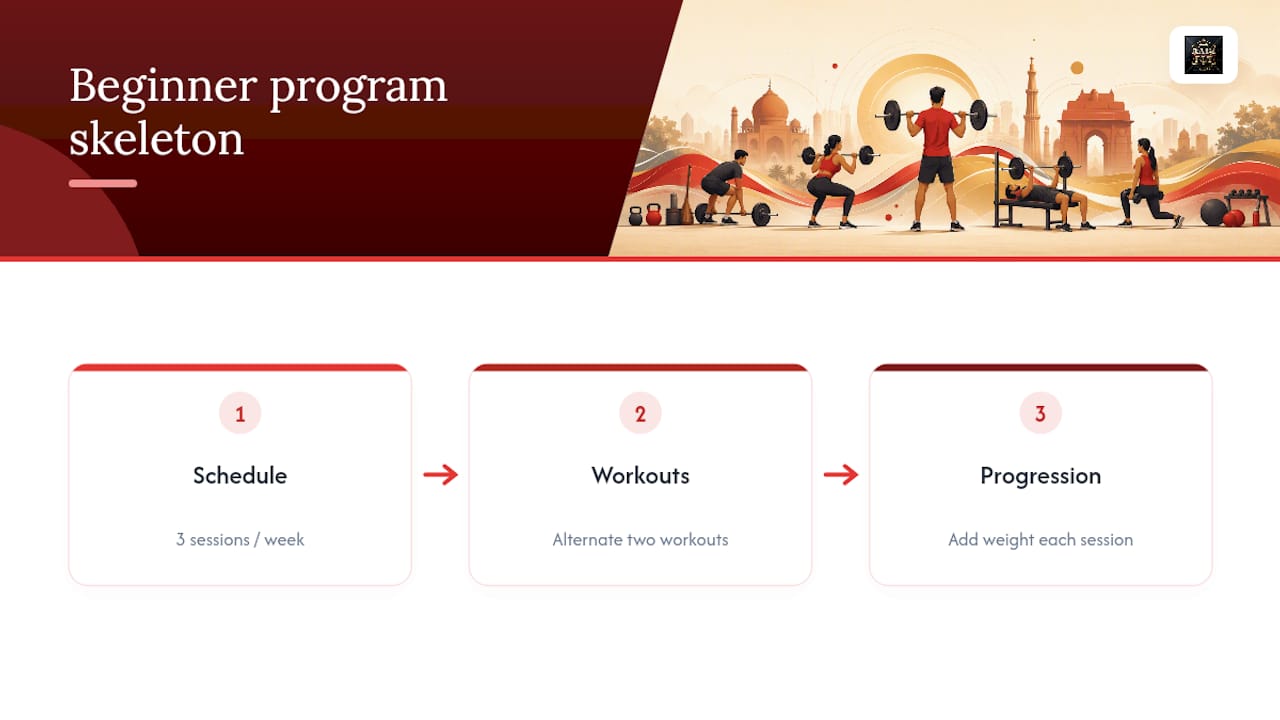
Every credible novice programme shares the same skeleton: a handful of compound lifts, three sessions a week, and a rule that says "add weight until you can't." The variations below suit different equipment access and time budgets, but they all follow that same novice progression logic, alternating two workouts and adding load every session.
The 3-day 5x5 barbell template
This is the workhorse of beginner strength training, and for good reason. You train three non-consecutive days (Monday, Wednesday, Friday works well), alternating two workouts:
- Workout A: Squat 5x5, Bench Press 5x5, Barbell Row 5x5
- Workout B: Squat 5x5, Overhead Press 5x5, Deadlift 1x5
You add weight to every lift, every session, as long as you complete all the prescribed sets and reps. A typical session runs 45 to 60 minutes once you factor in warm-up sets. The 5x5 structure has stayed popular for decades precisely because it is boring in the best way: no decisions to make, just weight to add.
The Starting Strength-style novice A/B split
This template swaps some of the volume for slightly heavier singles and different accessory choices:
- Workout A: Squat 3x5, Press 3x5, Deadlift 1x5
- Workout B: Squat 3x5, Bench Press 3x5, Power Clean or Chin-ups
The difference from the 5x5 approach is subtle but meaningful. Fewer working sets per session on the pressing and pulling movements means less accumulated fatigue, which suits people who recover more slowly or who are older than the typical gym-going twenty-something. Choose this over the 5x5 if you find five sets of squats leaves you too fried to press or pull with good form.
A 4-week home routine with no equipment
Not everyone has barbell access, and that shouldn't delay starting. A four-week bodyweight block, built around goblet squats or bodyweight squats, push-ups, inverted rows or resistance-band rows, and glute bridges or single-leg Romanian deadlifts, still applies the same progression logic: add reps or resistance-band tension weekly rather than plates. Aadifit's 4-week beginner workout plan and its no-equipment home routine both follow this compound-first structure, and they're a sensible starting point if a gym membership isn't part of the plan yet.

An 8-week gym option for higher frequency
Once the basic linear progression on three days a week starts to slow, some beginners shift to a five-day upper/lower or push/pull/legs split across an 8-week block. This suits people who enjoy training often and want more exercise variety, but it isn't necessary for early progress. Save it for after the first two or three months.
Which one should you choose? If you have barbell access and want maximum simplicity, take the 5x5. If you recover slowly or want lighter daily fatigue, take the Starting Strength-style split. If you're training at home, the 4-week bodyweight block gets you moving without a single plate.
How do you know when to add weight or deload?
Progression in a beginner strength program follows one rule: if you complete every prescribed set and rep with good form, add weight next session. That's the entire engine behind early strength gains, and it's why starting light matters more than starting impressive. A lighter opening weight buys you more sessions of pure "just add weight" progress before you ever have to think about programming.
Practical increments matter here. On the squat and deadlift, gradually add small amounts of weight each session to start; on the bench press and overhead press, smaller increments keep the bar moving longer before you stall.
When you fail to complete all reps for two sessions running, that's a stall, and it calls for a deload rather than more attempts at the same weight. A simple checklist handles it:
- Missed once: try the same weight again next session, focus on bar speed and technique.
- Missed twice in a row: reduce the weight by 10%, then resume adding smaller increments from there.
- Missed repeatedly at multiple lifts: check sleep, food intake and stress before touching the programme itself.
- Technical breakdown, not fatigue: pause progression and drill the movement pattern at a lighter weight for a week.
You don't need to chase failure on every set to grow stronger. Research on rep effort shows that stopping one to three reps short of failure produces strength and muscle gains comparable to training to failure, with noticeably less accumulated fatigue. That's why 8 to 12 reps at a challenging but controlled effort is a sound working range for beginner accessory work, even though the main lifts in a linear progression programme typically use lower rep counts like five.
Pro Tip: Write every working set's weight, reps and how many reps felt left "in the tank" in a notebook or app. When two sessions in a row show the same number scribbled next to a failed set, that's your deload signal, not a hunch.
Which exercises matter most for a beginner?
Five movement patterns produce the vast majority of a novice's strength gains: squat, hinge, press, pull and row. Everything else is accessory work layered on top.
- Squat: Sit back and down, knees tracking over toes, chest up. This builds leg and core strength faster than almost anything else.
- Hinge (deadlift or Romanian deadlift): Push hips back before bending knees, keep the bar close to your shins. Trains the entire posterior chain.
- Press (overhead or bench): Brace the core, press in a straight line, avoid flaring elbows too wide. Builds shoulder and chest strength.
- Pull (chin-up or lat pulldown): Pull elbows down and back, avoid swinging. Balances the pressing work and protects shoulder health.
- Row (barbell or dumbbell): Keep the back flat, pull to the lower ribs, squeeze the shoulder blades. Strengthens the upper back.
If barbells aren't available or a joint is cranky, sensible substitutions keep the same training effect. Goblet squats replace the barbell squat for anyone still building confidence in the pattern. Single-leg work such as split squats covers unilateral strength when loading heavy isn't an option. Band or dumbbell rows stand in for barbell rows, and a dumbbell Romanian deadlift covers the hinge pattern without a loaded barbell.
Warm up with two to three minutes of light cardio and dynamic movement prep (leg swings, band pull-aparts, bodyweight squats), then take two or three ramping sets at increasing weight before your first working set. This primes the joints and grooves the movement pattern before it matters under load.

Film your sets from the side on your phone once a week. Comparing your squat depth or bar path against a coaching resource or a qualified trainer catches technique drift long before it becomes a nagging injury.
How should you structure your training week?
Three sessions a week is the default for barbell linear progression, and there's a clear reason: it gives your nervous system 48 hours or more to recover between sessions on the same lifts, which is exactly how fast beginners adapt. If your schedule genuinely can't fit three sessions, two sessions a week still builds real strength and is far better than an ambitious plan you abandon after a fortnight.
A typical session runs like this:
- Warm-up (5 to 10 minutes): light cardio plus movement prep for the joints you're about to load.
- Main lifts (30 to 40 minutes): your compound movements, with 2 to 3 minutes rest between heavy sets so you can hit every rep with good form.
- Accessory work (10 to 15 minutes): rows, curls, core work, one to two exercises at 8 to 12 reps.
- Cool down (5 minutes): light stretching or walking.
Once the basic template feels easy, add volume gradually. An extra set on one accessory lift, or a slightly longer accessory circuit, is enough. Adding two new exercises and doubling your session length in the same week is the fastest way to wreck the momentum you've just built.
What should you eat and how much should you sleep?
Protein intake matters more than any other dietary variable for a beginner building strength. Aim for roughly 1.6 to 2.2g of protein per kilogram of bodyweight daily, spread across meals: eggs, paneer, dal, chicken, fish, Greek yoghurt and whey protein all count toward that target.
Calories should sit at maintenance or a small surplus (around 200 to 300 calories above maintenance) if the goal is visible muscle growth alongside strength, or at maintenance if the aim is recomposition without much weight change. Progressive resistance training delivers meaningfully better results when recovery keeps pace with training stress.
- Sleep 7 to 9 hours; strength adaptation happens during recovery, not during the workout itself.
- Stay hydrated, particularly around training sessions.
- Take at least one full rest day between sessions targeting the same muscle groups.
Creatine monohydrate is one of the most evidence-backed supplements available for strength gains, typically dosed at 3 to 5g daily, and it's worth considering once the basics of food and sleep are already in place.
Do you need medical clearance before starting?
If you have a pre-existing heart condition, joint problem, or haven't exercised in years, get medical clearance before starting, and consider a movement screening with a qualified trainer or physiotherapist to catch limitations early. Guidance from health authorities recommends this step for anyone with existing conditions, alongside a general minimum of two strength sessions a week for adults.
Common modifications solve most joint issues without abandoning the lift entirely: box squats reduce knee strain on a cranky knee, elevated deadlifts (starting the bar from blocks or a rack) shorten the range for tight hamstrings, and partial range presses work around shoulder impingement while it heals.
- Sharp, localised joint pain that doesn't ease with lighter loads: stop and get it assessed.
- Persistent fatigue or performance decline across multiple weeks despite adequate rest: a sign of overtraining, not weakness.
- Numbness or tingling during a lift: stop immediately and see a professional.
Pro Tip: Track how you feel, not just what you lift. A programme that ignores climbing fatigue for the sake of hitting a number on the bar is the fastest route to a setback.
Why simplicity beats complexity for new lifters
Most beginners overthink programming long before they've earned the right to. The instinct to chase specialisation, split routines, or advanced periodisation in week one ignores a basic truth: novice gains come from consistent effort and progressive overload applied to a handful of compound lifts, not from clever programme design. I'd rather see someone run an unglamorous 5x5 for four months than hop between three "optimised" routines they never stick with long enough to see results.
What changes the equation is data. A beginner following a fixed template still has to guess when to deload, whether their squat depth is drifting, or if their protein intake actually matches their training load. Personalised, adaptive coaching that tracks these variables in real time removes that guesswork, catching technique breakdown and fatigue patterns before they turn into stalled progress or injury. Simplicity in the programme and precision in the feedback loop aren't opposites. They're the combination that actually works.
— Aditya
AadiFit: build your beginner program around real feedback, not guesswork
A printed 5x5 template tells you what to lift. It can't tell you whether your squat depth is drifting, whether your protein intake matches your training load, or when your specific body needs a deload versus another hard week. That's the gap Aadifit's coaching platform is built to close, using continuous data from your training, nutrition and recovery to adjust your beginner strength program as your body responds to it.
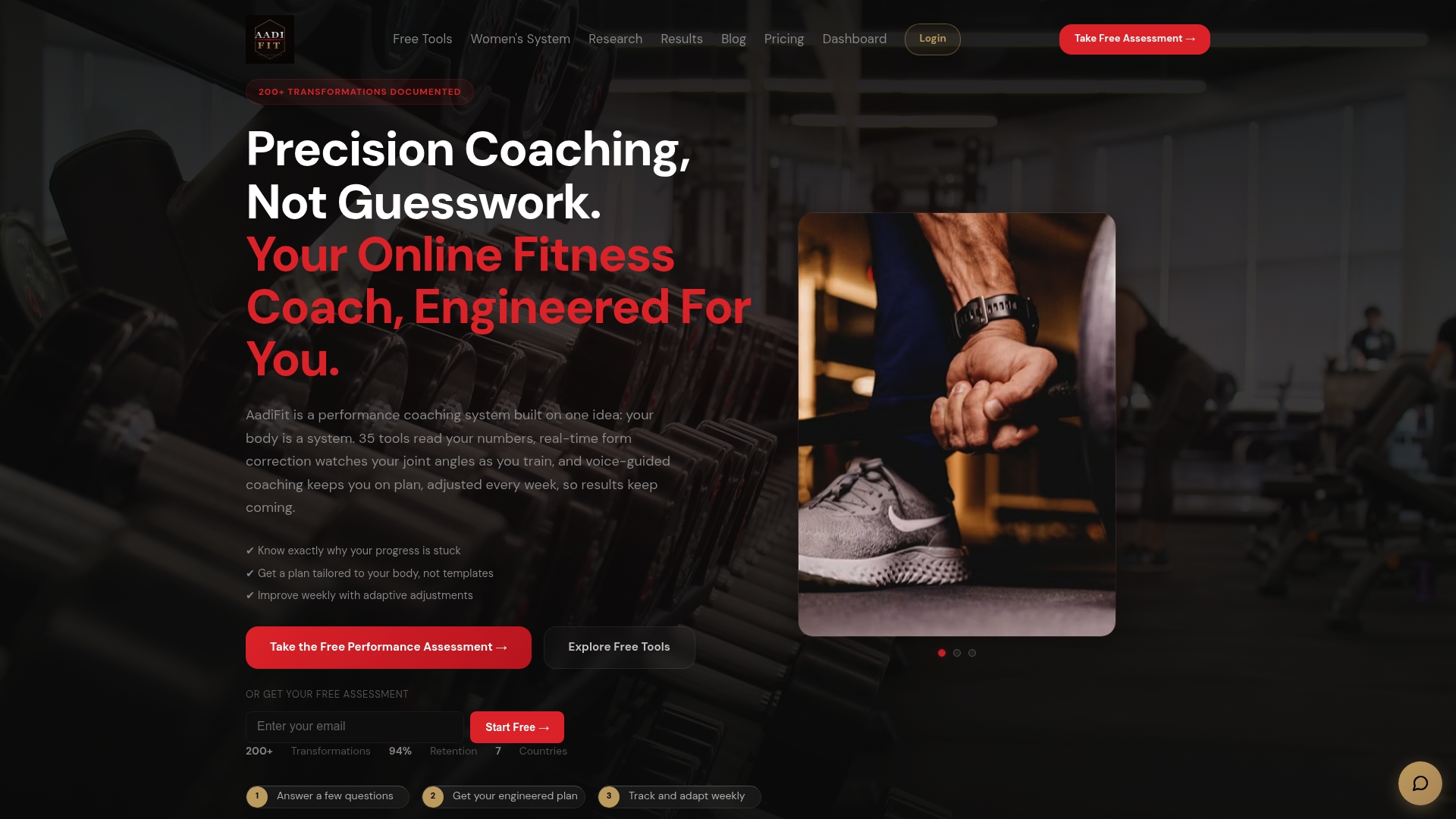
Aadifit's free workout generator builds a starter routine around your equipment and schedule in minutes, a genuinely low-friction way to get your first programme without committing to anything. From there, real-time form correction technology flags technique drift on your main lifts, and the platform's 35 research-backed tools handle everything from macro targets to plateau tracking, so you're not stalling on the bench press because of an undiagnosed calorie deficit. If you want a fully guided beginner experience, the Performer plan runs at ₹1,499 a month and adapts your programme as you progress; for one-to-one coaching, the Personal plan is priced at ₹6,000 a month. Start with the free fitness assessment to see where your training currently stands.
Sources
The Starting Strength novice programme explains the original A/B linear progression logic in full detail. NPR's strength exercise guide covers the evidence on training effort and rep ranges. Speak to a doctor before starting if you have any pre-existing health condition.
- To get stronger, start with these 6 strength-building movements — NPR
- Starting Strength novice programming — Starting Strength
- Resistance training review — NCBI PMC
FAQ
What is a good beginner strength program?
A good beginner strength program uses simple compound lifts (squat, deadlift, press, row) trained three times a week, with weight added each session as long as you complete every prescribed rep. The 5x5 template and the Starting Strength A/B split are the two most widely used versions.
What is the 3-3-3 rule for strength training?
There's no single, universally agreed definition of a "3-3-3 rule" in strength training literature, so treat any version you see with caution. What is well-supported is the underlying pattern it usually gestures at: training roughly three days a week with three main lifts per session, which mirrors standard novice programming.
What is a good starting strength program for beginners?
The Starting Strength-style novice programme alternates two workouts across three non-consecutive training days, pairing squats every session with alternating deadlifts, presses and pulling work. It suits beginners who want a slightly lighter overall training load than the 5x5 template while still adding weight every session.
How should a beginner start strength training?
Start with two to three sessions a week of full body compound lifts at a light, manageable weight, focusing on technique before load. Consistency matters more than intensity in the first few months, so even two sessions a week beats an ambitious plan abandoned after two weeks.
How much does Aadifit cost for a beginner program?
Aadifit's Performer plan costs ₹1,499 per month and includes adaptive programme adjustments, while the Personal plan with one-to-one coaching is priced at ₹6,000 per month, both listed on the Aadifit pricing page. The Explorer plan and free tools, including the workout generator, are available to try before committing to a paid tier.
Recommended
- Free Workout Generator, Built for Your Goals
- Best Workout Plan for Beginners: 4-Week Guide
- Indian Diet Plan for Muscle Gain: High-Protein Meals & Macros
Made with BabyLoveGrowth to grow visibility across Google and AI search