
Yes, progressive strength training is recommended for most women with PCOS. It improves insulin sensitivity, tends to lower certain androgen markers, and builds functional strength that resistance-free cardio simply cannot match. Start with two to three full-body sessions per week, add daily walking, and apply progressive overload consistently for at least eight to twelve weeks before judging results.
TL;DR:
- Resistance training three times weekly can improve insulin sensitivity, hormonal markers, and strength in women with PCOS, but individual results vary.
- Progressive overload with small, consistent increases in weight or reps is essential, along with proper recovery and avoidance of overtraining signs.
- Combining strength sessions with daily walks and maintaining balanced protein intake supports metabolic health and hormonal balance.
- Short, structured workouts with emphasis on form and gradual progression increase adherence and minimize injury risk, especially for beginners.
- Tailoring the program to personal needs and incorporating cycle-aware adjustments enhances effectiveness and addresses PCOS-specific challenges.
Table of Contents
- Why does strength training help with PCOS?
- How much strength training and cardio do you actually need?
- What does a PCOS-friendly strength workout plan look like?
- How do you choose exercises and know you're progressing?
- How do you avoid overtraining and protect your hormones?
- What should you eat to support strength training with PCOS?
- What should you look for in PCOS-specific coaching?
- Which PCOS symptoms respond to strength training?
- Can strength training improve your mood and confidence with PCOS?
- How do you track progress and know when to adjust your plan?
- What stops women with PCOS from sticking to strength training?
- Where the guidance in this article comes from
- Get a PCOS-friendly training plan built around your body
- A realistic word on consistency and expectations
- Sources
- FAQ
Why does strength training help with PCOS?
Muscle tissue is the largest site of glucose disposal in the body. When you build more of it and train it regularly, you create a bigger, more efficient sink for the glucose circulating in your blood. For women with PCOS, where insulin resistance sits at the root of most downstream symptoms, from irregular cycles to stubborn weight gain, this matters more than almost any other physiological lever available through lifestyle change.
A 2018 case-control trial put this to the test directly. Women with PCOS followed a progressive resistance training programme three times a week for four months. The result was measurable increases in maximum strength alongside reductions in testosterone and glycaemic markers compared with controls. That is a meaningful signal, not just for strength but for the hormonal profile that drives so many PCOS symptoms.
The wider evidence base is smaller than we would like, but it points the same direction. A scoping review covering multiple resistance training trials found positive, if preliminary, effects across a cluster of outcomes: waist circumference, body fat percentage, lean mass, testosterone, and fasting glucose. A 2024 systematic review and meta-analysis reached a similarly cautious conclusion, reporting generally favourable but statistically mixed effects on glycaemic and lipid markers. The heterogeneity and small sample sizes across studies limit how confidently we can generalise the pooled results.
Here is what that actually means for you as a reader. The mechanisms are well understood and biologically plausible. The trials that exist are encouraging. But most are small, run over a matter of months rather than years, and vary in how they measure outcomes. That is not a reason to dismiss strength training. It is a reason to expect real but gradual change, measured in months, not days.
What the current evidence shows:
- Progressive resistance training three times weekly for several months increased maximal strength and reduced testosterone and glycaemia in one case-control trial.
- Resistance training is linked to improvements in waist circumference, body fat percentage, and lean mass across several small trials.
- Meta-analytic data on glycaemic and lipid markers is favourable in direction but not always statistically significant once studies are pooled.
- No trial claims resistance training reverses PCOS. The honest framing is symptom management and metabolic improvement, not a cure.
The evidence in one line: small trials and one meta-analysis consistently point toward improved insulin sensitivity, strength, and androgen profiles from structured resistance training, but sample sizes remain modest enough that individual results will vary.
None of this means strength training is a guaranteed fix for every symptom. PCOS presentations vary hugely between individuals, and the same protocol that works for one woman may need adjusting for another with a different baseline fitness level, insulin resistance severity, or comorbidity profile. That is precisely why the guidance further down this article leans so heavily on individualisation rather than a single fixed template.
How much strength training and cardio do you actually need?
The Exercise and Sport Science Australia position statement, aligned with the international evidence-based PCOS guideline, sets clear weekly targets. Adults with PCOS should aim for a guideline-recommended range of moderate to vigorous aerobic activity per week, combined with muscle-strengthening work on two non-consecutive days. For greater benefits, more aerobic activity towards the higher end of the range is suggested while maintaining two weekly strength sessions.
Translated into a practical week, this looks less intimidating than the raw numbers suggest.
| Guideline target | Practical weekly translation |
|---|---|
| moderate to vigorous aerobic activity per week | 20 to 30 minutes of brisk walking, most days |
| Muscle strengthening, two non-consecutive days minimum | Two full-body strength sessions, at least one rest day between |
| Higher benefit target: 250 minutes moderate (or 150 vigorous) | Daily walks plus two to three strength sessions |
| Realistic session length for beginners | 30 to 45 minutes per strength session |
Daily walking deserves its own mention here, separate from the formal aerobic minutes. Short, consistent walks, particularly 8,000 to 10,000 steps spread across the day and a stroll after meals, help blunt post-meal glucose spikes without adding training stress. A 20 to 30-minute walk within an hour of eating is a low-cost habit that pairs naturally with a strength-focused week, and it does not compete with your recovery in the way that additional high-intensity cardio sessions can.
How to scale this to your starting point:
- If you are new to structured exercise, begin with two strength sessions a week and daily walks of 15 to 20 minutes, building up gradually.
- If you already train informally, aim for three strength sessions and layer in the higher-end aerobic target once your recovery allows it.
- If fatigue or joint issues limit session length, shorter, more frequent sessions (20 to 25 minutes) beat skipped workouts.
- Non-consecutive strength days matter: your muscles need at least one day to adapt between sessions, so avoid stacking them back to back.
Three sessions a week is the sweet spot for most women once the body adapts to the initial two-session phase. Beyond that, the marginal benefit tends to plateau unless you are training for performance goals beyond general PCOS management.
What does a PCOS-friendly strength workout plan look like?
You do not need a gym membership or years of lifting experience to start. What you need is a structure that applies progressive overload consistently, because unplanned, random workouts rarely produce the metabolic or hormonal changes the research describes. Trials showing benefit used progressive linear periodisation, meaning the training load increased in a planned, structured way across weeks and months rather than randomly.
Starter plan: two full-body sessions per week (weeks 1 to 4)
- Warm-up (5 to 8 minutes): brisk walk or bike, followed by bodyweight squats, arm circles, and hip openers.
- Squat pattern: bodyweight squat or goblet squat, 3 sets of 10 to 12 reps.
- Hinge pattern: glute bridge or Romanian deadlift with light dumbbells, 3 sets of 10 to 12 reps.
- Push pattern: incline push-up or dumbbell shoulder press, 3 sets of 8 to 10 reps.
- Pull pattern: resistance band row or dumbbell row, 3 sets of 10 to 12 reps.
- Core/carry: plank hold, 3 sets of 20 to 30 seconds, or farmer's carry, 3 sets of 20 to 30 metres.
- Cool down: 5 minutes of walking and light stretching.
Progression rule for this phase: once you can complete all sets at the top of the rep range with good form, add a small amount of resistance, roughly 1 to 2.5 kilograms, or move from a resistance band to light dumbbells. Do not chase heavier loads before your technique is solid; the research base for PCOS-specific benefit comes from consistent progressive loading, not from lifting heavy too soon.
Intermediate plan: three full-body sessions per week (weeks 5 to 12)
At this stage, you split the same movement patterns across three sessions with slightly different emphasis, allowing more volume without overloading any single muscle group in one sitting.
- Session A (squat-dominant): back squat or goblet squat, walking lunges, dumbbell shoulder press, plank.
- Session B (hinge-dominant): Romanian deadlift, dumbbell row, incline push-up, farmer's carry.
- Session C (mixed/accessory): step-ups, glute bridge, band pull-apart, dead bug or bird dog.
Set and rep ranges shift to 3 to 4 sets of 8 to 12 reps per exercise, with a rest of 60 to 90 seconds between sets. Weekly progression follows a simple rule: add one rep per set until you reach the top of the range, then add load and drop back to the bottom of the range. Every four weeks, schedule a lighter deload week, roughly 60% of your usual volume, to let your joints and nervous system recover fully before the next progression block.
A sample weekly microcycle for the intermediate phase:
- Monday: Session A (strength)
- Tuesday: 20 to 30 minute walk
- Wednesday: Session B (strength)
- Thursday: 20 to 30 minute walk or gentle mobility work
- Friday: Session C (strength)
- Saturday: optional short conditioning (15 to 20 minutes) or rest
- Sunday: rest or active recovery walk
If you train at home with minimal equipment, resistance bands and one or two sets of adjustable dumbbells cover every movement pattern above. Bodyweight variations, step-ups on a sturdy chair, suitcase carries with filled water bottles, and tempo push-ups, keep the same principles intact without a single piece of gym kit.
How do you choose exercises and know you're progressing?
Structure your sessions around movement patterns, not muscle groups; it is simpler to plan and harder to get wrong. Every effective PCOS resistance training programme covers a squat, a hinge, a push, a pull, a loaded carry, and some core stability work each week. If a particular exercise causes joint pain or feels awkward, swap it for another exercise within the same pattern rather than dropping the pattern entirely: a goblet squat can replace a back squat, a band row can replace a barbell row.
Progression needs a measurable anchor, otherwise it is guesswork. Three metrics work well together:
- Load: increase weight in small steps, typically 1 to 2.5 kilograms once you hit the top of your rep range with good form.
- Reps: add one rep per set before adding weight, particularly with bodyweight or resistance band work where load increments are harder to control.
- Perceived effort: use a simple rate of perceived exertion or reps-in-reserve scale. If your last set feels like you could do four or five more reps, the weight is too light; if you cannot maintain form for the prescribed reps, it is too heavy.
Without an explicit progression rule like this, most trainees plateau somewhere around the eight to twelve week mark, not because their bodies stop adapting but because the training stimulus stops changing. That plateau is avoidable with the small, deliberate load or rep increases described above.
Pro Tip: Film your squat or hinge pattern from the side on your phone once every couple of weeks. Comparing footage over time reveals technique drift, like a rounding lower back or knees caving inward, far more reliably than how the movement feels in the moment.
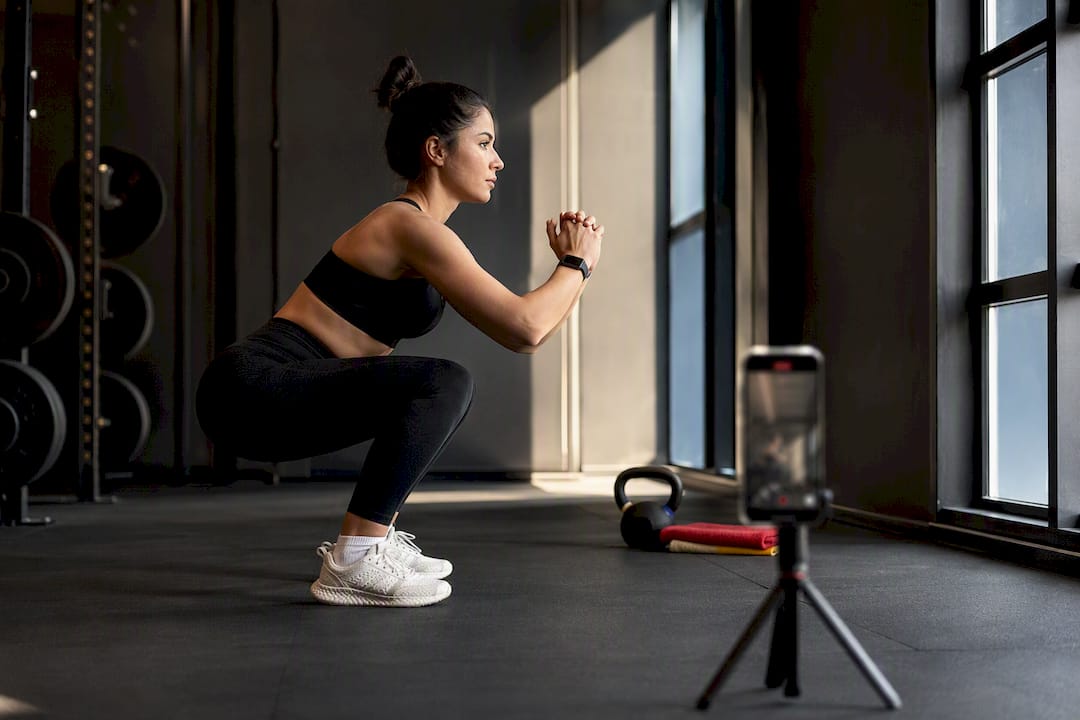
Form-first cues matter more than intensity in the early months. Keep your ribcage stacked over your pelvis during squats and hinges, drive through the whole foot rather than the toes, and avoid holding your breath through an entire set. If pain, rather than muscular fatigue, shows up during any movement, stop and reassess rather than pushing through.
Supervised or coached sessions consistently show higher adherence in feasibility studies, particularly for women with more complex presentations or low starting fitness. If you have joint issues, a very low baseline fitness level, or another condition alongside PCOS, a session or two with a qualified coach to check your form is worth the investment before you train unsupervised.
How do you avoid overtraining and protect your hormones?
More is not automatically better when you are training with PCOS, and pushing too hard too often can work against the very hormonal balance you are trying to improve. Chronic, high-volume training without adequate recovery raises cortisol, and sustained cortisol elevation can blunt the insulin-sensitivity gains you are working for in the first place.
Watch for these warning signs, and treat more than one appearing together as a signal to pull back:
- Sleep quality declining, or new difficulty falling or staying asleep.
- Persistent fatigue that does not lift after a rest day or two.
- Menstrual cycle changes beyond your usual pattern, including missed or unusually irregular periods.
- Mood swings, irritability, or anxiety that feels disproportionate to your usual baseline.
- Resting heart rate creeping upward, or workouts that feel harder than usual at the same intensity.
A practical recovery rule: if two or more of these signs appear in the same week, cut training volume by roughly a third for seven to ten days before resuming your normal programme.
Build a deload week into your plan every four to six weeks regardless of how you feel, reducing volume to around 60% of normal. Prioritise seven to nine hours of sleep, since sleep debt is one of the fastest routes to elevated cortisol and impaired insulin sensitivity. Treat stress management, whether that is short walks, breathing exercises, or simply protecting your evenings, as part of the training programme rather than something separate from it.
Conditioning and HIIT deserve a specific caution. Daily high-intensity intervals stacked on top of strength training push many women with PCOS toward the same cortisol-driven recovery problems described above. One or two short conditioning sessions a week, kept to 15 to 20 minutes, once your strength training is consistent and well-tolerated, is a reasonable ceiling for most people. If your sleep or cycle regularity worsens after adding conditioning work, that is your cue to remove it rather than push through.
What should you eat to support strength training with PCOS?
Training adaptations depend on what you feed them. Protein is the priority macronutrient for anyone doing progressive resistance work, and a practical target for most women with PCOS sits around 1.2 to 1.6 grams per kilogram of bodyweight per day, spread across three to four meals rather than loaded into one. This range supports muscle repair without requiring a dramatic overhaul of your existing eating pattern.
Timing matters less than total daily intake, but having a source of protein within a couple of hours either side of your strength session gives your muscles the raw material to adapt while insulin sensitivity is naturally elevated post-exercise. A simple combination of protein and slow-digesting carbohydrate, such as eggs with wholegrain toast or Greek yoghurt with oats, works well in that window.
Nutrition priorities that pair with a strength training routine:
- Protein spread across the day, roughly 1.2 to 1.6 g/kg bodyweight, rather than concentrated in one meal.
- Fibre-rich carbohydrates paired with protein at each meal to blunt post-meal glucose spikes.
- Consistent meal timing, since irregular eating patterns can worsen the insulin resistance already present in PCOS.
- Adequate total calorie intake to support training recovery. Under-eating undermines both strength gains and hormonal balance.
On supplements, the evidence base is narrower than marketing claims suggest, so keep expectations proportionate. Creatine monohydrate, taken at 3 to 5 grams daily, has a well-established safety profile in women and is one of the few supplements with a plausible mechanism for supporting strength gains during a resistance training programme. It is not a PCOS-specific treatment, but it is one of the more evidence-backed additions available if you are already training consistently.
Be sceptical of any product marketed as a quick fix for PCOS symptoms. If you take medication for insulin resistance, thyroid function, or any other condition, check with your doctor or pharmacist before adding a new supplement, since interactions are possible even with generally safe compounds like creatine.
What should you look for in PCOS-specific coaching?
Not every coach or programme understands the nuances of training with PCOS, and a generic plan lifted from a general fitness template can miss the individualisation that actually drives results. Position statements on PCOS exercise are explicit that programmes should be individualised, because many women present with low starting physical capacity, joint sensitivity, or psychosocial barriers that a one-size-fits-all plan simply ignores.
Before committing to any coaching service, check for the following:
- Does the coach ask about your cycle regularity, symptom history, and any comorbidities before writing a plan?
- Is there a system for tracking recovery, not just workout completion, so training adjusts when fatigue or stress rises?
- Does the programme apply progressive overload deliberately, with a clear rule for when and how load increases?
- Is feedback on technique available, rather than a static PDF with no correction loop?
Aadifit builds its coaching around these exact principles. The platform uses cycle-aware programming that adjusts training load across your cycle phases, real-time form correction technology that flags technique issues as you train, and a set of 35 research-backed tools covering training, nutrition, and recovery tracking. A free assessment identifies your current limiting factors before any plan is written, which matters more for PCOS than for general fitness goals, since starting capacity varies so widely between individuals.
Red flags to avoid: any programme promising rapid symptom reversal, plans that ignore your menstrual cycle entirely, or coaching with no mechanism for adjusting load based on how your body actually responds week to week.
Which PCOS symptoms respond to strength training?
Strength training targets several PCOS symptoms directly, rather than working around them. Insulin resistance, present in most women with PCOS regardless of body weight, improves as muscle mass increases and becomes a more active site of glucose uptake. You may notice this first as more stable energy through the day, rather than as a number on a lab report.
Irregular or absent periods often trace back to the same insulin and androgen imbalances that resistance training influences. Improvements here tend to lag behind strength gains by months, not weeks, since hormonal cycles need sustained metabolic change before menstrual regularity shifts.
Excess hair growth and acne, both driven by elevated androgens, may soften gradually as testosterone levels respond to training, mirroring the reductions seen in the 2018 progressive resistance trial. Weight distribution, particularly visceral fat around the abdomen, is another area where resistance training shows measurable change in body composition studies, often before the number on the scale moves significantly.
Fatigue, frequently reported by women with PCOS and sometimes dismissed as unrelated, often improves as insulin sensitivity and sleep quality respond to consistent, well-recovered training. None of these changes happen overnight. Most trial data reflects improvements measured over three to four months of consistent training, not single weeks.
Can strength training improve your mood and confidence with PCOS?
Physical symptoms are only part of the PCOS picture. The mental health toll, anxiety, low mood, body image struggles, and a sense of losing control over your own body, is real and well documented among women managing the condition. Strength training addresses this territory in ways that go beyond the physiological.
Completing a structured session, tracking a rep increase, or lifting a weight you could not manage a month ago gives you a concrete, visible marker of progress that PCOS often denies you elsewhere. That sense of competence tends to spill into other areas of confidence and self-image, particularly for women who have spent years feeling like their body is working against them.
Exercise more broadly is linked to reduced anxiety and improved mood through several mechanisms, including regulated cortisol patterns and improved sleep quality, both of which strength training supports when programmed sensibly rather than excessively. The structure itself matters too: a fixed, achievable weekly session count gives you something predictable to hold onto, which can counter the unpredictability that PCOS symptoms often bring to daily life.
This is not a claim that strength training resolves clinical anxiety or depression. It is a realistic observation that consistent, achievable physical progress correlates with better mood and self-esteem in the general exercise literature, and there is no reason to expect women with PCOS to be an exception. If mood symptoms are significant or persistent, pair training with proper mental health support rather than treating exercise as a substitute for it.
How do you track progress and know when to adjust your plan?
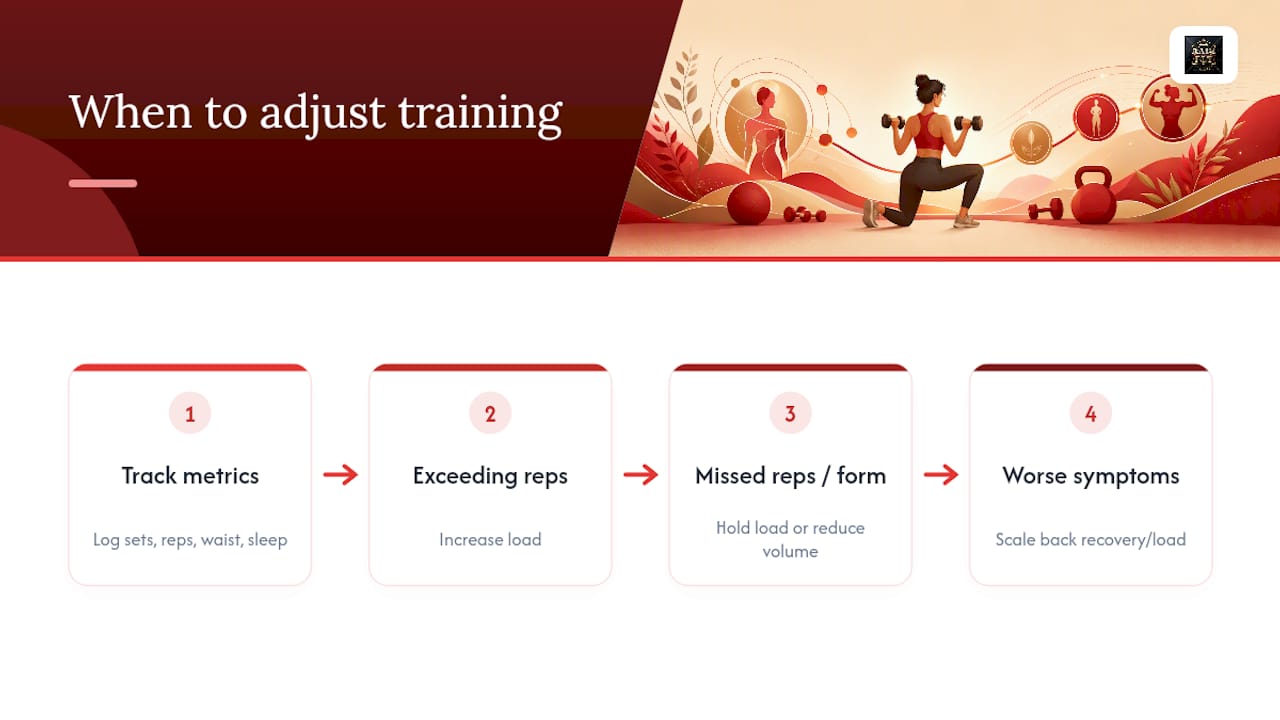
Scale weight is one of the least useful metrics for tracking PCOS training progress, since body composition and water retention shift independently of fat loss or muscle gain. Better markers include the load you lift for key exercises, how many reps you complete at a given weight, waist circumference measured monthly, and simple subjective markers like energy levels and sleep quality.
Keep a basic training log, even a simple notebook or phone note works, recording weight, sets, and reps for each session. Reviewing this every two to four weeks tells you whether you are actually progressing or plateauing, which is far more reliable than relying on memory or how a session felt in the moment.
Adjust your plan when the data tells you to, not on a fixed schedule. If you are consistently exceeding your rep targets with room to spare, increase load. If you are missing reps or your form breaks down repeatedly, hold the current load another week or reduce volume slightly. If menstrual symptoms, energy, or sleep worsen over two or more weeks, treat that as a signal to scale back before it becomes a bigger setback.
Tools that consolidate this tracking, rather than scattering it across a notebook and a fitness app, make the review process faster and more honest. Aadifit's progress and plateau tracking tools are built around exactly this kind of week-to-week comparison, flagging when a metric stalls so you can adjust load or recovery before frustration sets in.
What stops women with PCOS from sticking to strength training?
Fatigue is the barrier mentioned most often, and it is a legitimate one rather than a motivation problem to push through. PCOS-related insulin resistance and poor sleep quality genuinely sap energy, which makes a demanding gym session feel disproportionately hard some days. The fix is not forcing intensity but adjusting session length: a shorter, lower-volume session still delivers a training stimulus, and consistency matters more than any single session's intensity.
Motivation dips are common when progress feels invisible, particularly since hormonal symptoms improve on a slower timeline than strength itself. Tracking objective markers, like the load lifted or reps completed, gives you evidence of progress during the months before symptom changes become noticeable, which helps sustain motivation through that gap.
Body image concerns, common in PCOS due to symptoms like weight gain or excess hair growth, can make gym environments feel unwelcome or exposing. Training at home with minimal equipment, or choosing quieter gym hours, removes that barrier without compromising the programme itself.
Time constraints are real for most women juggling work and other responsibilities. The 30 to 45 minute sessions outlined earlier in this article are designed around that constraint deliberately; a shorter, well-structured session beats a longer one that gets skipped because it feels unmanageable. If a fixed schedule keeps slipping, anchoring sessions to an existing habit, training straight after work rather than "finding time" later, tends to hold up better over several months.
Where the guidance in this article comes from
The programming and targets throughout this article draw on peer-reviewed research and a national position statement, not general fitness advice repurposed for PCOS. The Exercise and Sport Science Australia position statement sets the weekly activity targets referenced throughout. The 2018 progressive resistance training trial provides direct evidence of strength and hormonal changes from a structured programme. A scoping review of resistance training in PCOS and a systematic review and meta-analysis on glycaemic and lipid outcomes round out the evidence base, including its current limitations.
Get a PCOS-friendly training plan built around your body
There are coaching options that offer cycle-aware programming to adjust to hormonal phases, real-time form correction to catch technique errors during training, and progress tracking to flag plateaus before they cause long-term setbacks, providing an alternative to generic workout plans for PCOS strength training.
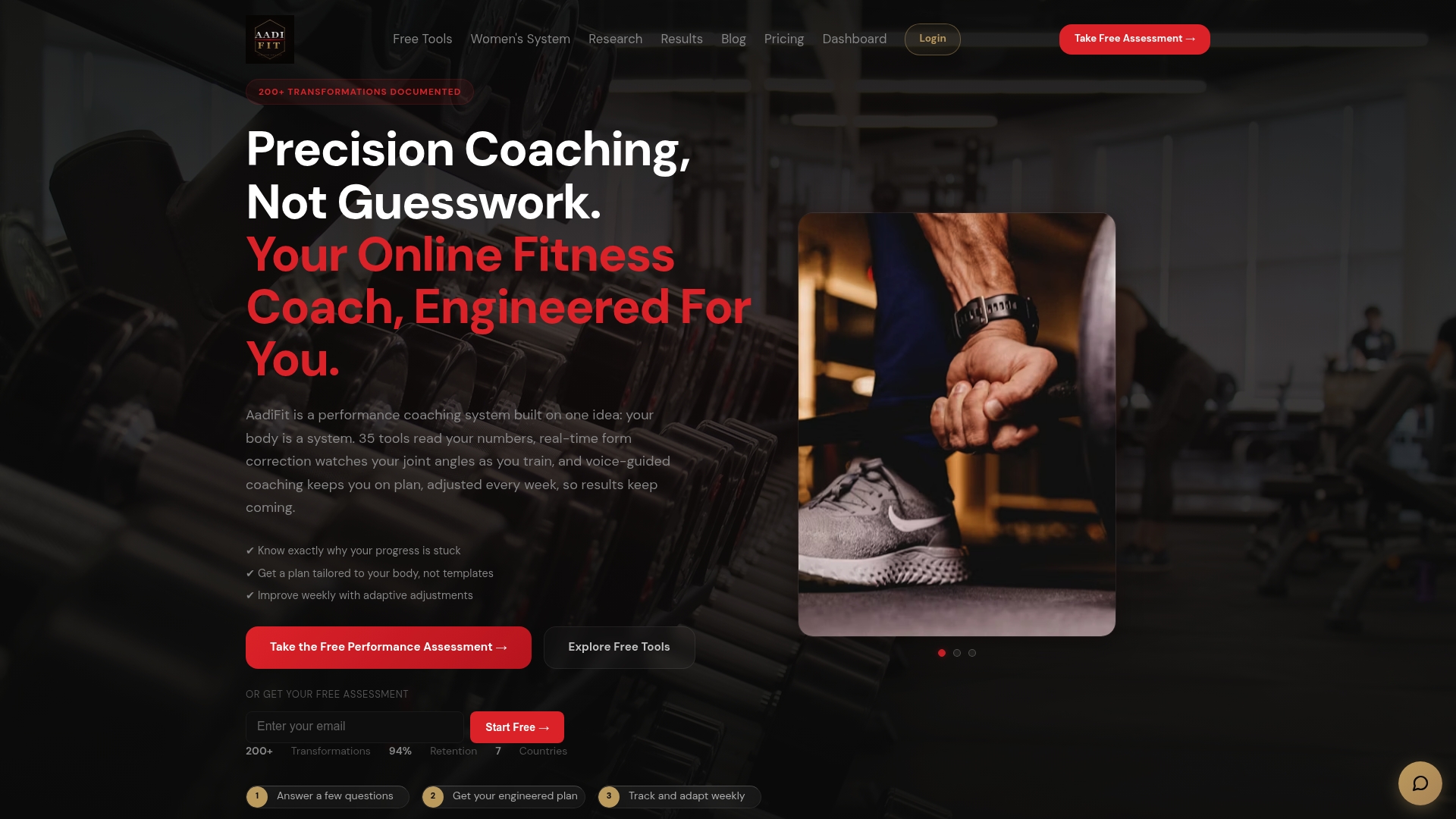
The platform's 35 research-backed tools cover the exact gaps this article has walked through: a free workout generator that builds progressive full-body sessions matching the structure described above, a free fitness assessment that identifies your current limiting factor before you commit to anything, and a dedicated hormonal health training system built for exactly the individualisation that PCOS demands. Paid coaching starts with the Performer plan at ₹1,499 per month, with Elite coaching at ₹3,999 per month and fully personalised 1:1 coaching through the Personal plan at ₹6,000 per month, all detailed on the pricing page. Start with the free assessment, see what your body actually needs, and decide from there whether structured coaching is the next step.
A realistic word on consistency and expectations
The research behind PCOS strength training is honest about its own limits: small sample sizes, short trial durations, and outcomes that vary between individuals. What it does not leave in doubt is the direction of travel. Progressive resistance training, done consistently over months rather than days, improves insulin sensitivity, strength, and often the androgen markers that drive so many visible PCOS symptoms.
Where I see women go wrong is not laziness. It is impatience, expecting a twelve-week programme to undo years of hormonal imbalance, and abandoning a plan at week six because the scale has not moved. Strength and lab markers change faster than menstrual regularity or visible symptom shifts. Track the numbers you can measure weekly, load lifted, reps completed, energy levels, and let the slower symptomatic changes catch up in their own time.
If you take one thing from this article, let it be this: a mediocre programme followed consistently beats a perfect programme abandoned after a month. Start with the free workout generator if you need a starting point, and speak to a doctor before beginning if you have joint issues, cardiovascular concerns, or another condition alongside PCOS.
— Aditya
This article is general information, not a substitute for advice from a qualified doctor. Consult a qualified healthcare professional about your own circumstances before acting on anything here.
Sources
- Exercise in the management of polycystic ovary syndrome: A position statement from Exercise and Sports Science Australia
- Hyperandrogenism enhances muscle strength after progressive resistance training ... in women with PCOS
- The effect of resistance training on glycemic indices and lipid profiles in PCOS: systematic review and meta-analysis
FAQ
Can you do strength training if you have PCOS?
Yes, strength training is not only safe for most women with PCOS but actively recommended by exercise physiology bodies. The Exercise and Sport Science Australia position statement specifically calls for muscle-strengthening activity on two non-consecutive days each week as part of standard PCOS management.
What is the 30/30/30 rule for PCOS?
The 30/30/30 rule is a popular social media routine involving 30 grams of protein within 30 minutes of waking, followed by 30 minutes of low-intensity exercise, typically walking. It is not a formally guideline-backed protocol for PCOS specifically, though the underlying components, morning protein and daily low-intensity movement, are broadly consistent with sensible blood sugar management.
How do Koreans treat PCOS?
There is no single national treatment approach unique to Korea for PCOS; management typically combines the same evidence-based pillars used internationally, including lifestyle changes, exercise, and medication where clinically indicated. Any claims of a distinct national protocol are not supported by the clinical guidance referenced in this article, and readers should rely on their own healthcare provider's guidance rather than country-specific folk remedies.
What exercises should you avoid with PCOS?
There is no exercise universally banned for PCOS, but excessive daily high-intensity interval training or chronic long-duration cardio without adequate recovery can raise cortisol and work against your insulin sensitivity goals. Prioritise structured strength training two to three times weekly, keep conditioning sessions short and infrequent, and adjust or pause any exercise that consistently worsens sleep, mood, or menstrual regularity.
How many strength sessions per week does PCOS strength training need?
Two sessions weekly is the guideline minimum, but three sessions tend to produce better strength and metabolic results once your body adapts to the initial workload. Space sessions on non-consecutive days to allow adequate recovery between full-body workouts.
What does Aadifit cost for PCOS coaching?
Aadifit's Performer plan is priced at ₹1,499 per month, Elite at ₹3,999 per month, and the fully personalised Personal coaching plan at ₹6,000 per month, all listed on the pricing page. An Explorer plan is also available, with pricing available on request through the same page.