
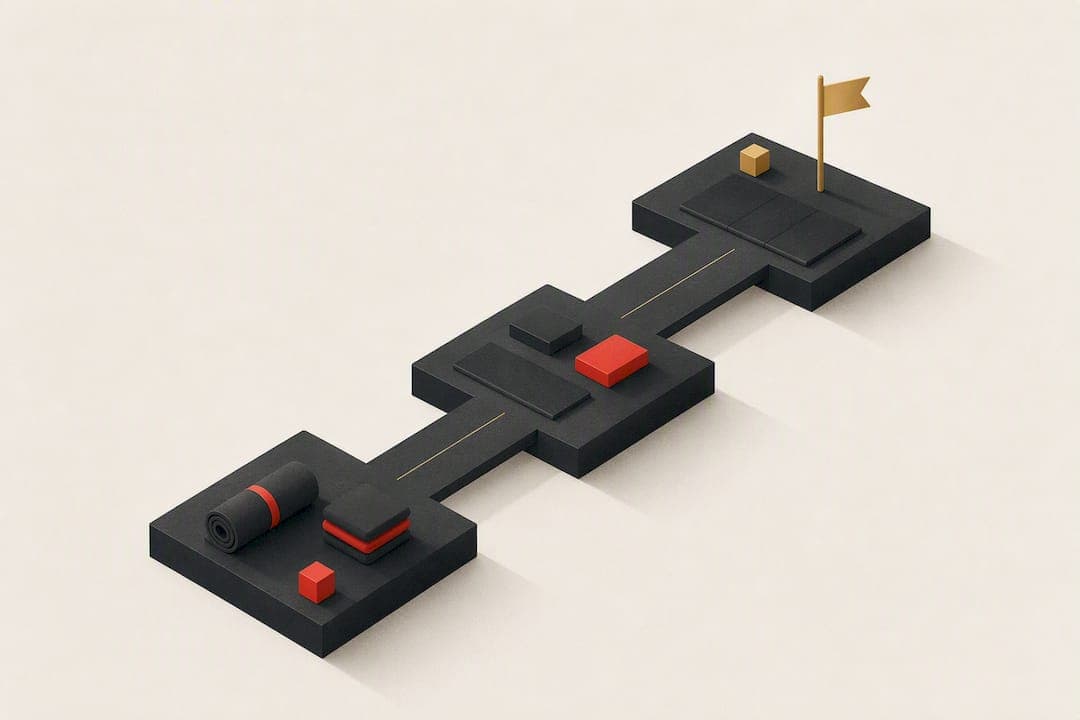
The safest postpartum workout plan starts with breathing and pelvic-floor activation, not crunches or cardio. From there, you move through three phases (reconnect, rebuild, return) over roughly 12 weeks or longer, guided by symptoms rather than the calendar. If you have not yet had your six to eight-week check, get medical clearance first. If you have, begin with 10-minute sessions and build from there.
TL;DR:
- Most postpartum exercises should start with pelvic-floor activation and breathing, progressing gradually based on symptom stability rather than fixed timelines.
- Healing markers like unchanged coning, minimal leakage, and absence of pelvic heaviness determine readiness to advance to stronger movements or heavier resistance.
- Gentle activity such as micro-sessions, short walks, and basic core exercises can begin immediately after uncomplicated vaginal birth but require longer wait after a cesarean.
- Progression should be guided by functional signs rather than calendar weeks, with regular symptom logging to monitor safe advancement.
- Personalized, data-driven programs can adjust recovery plans in real-time, reducing the risk of overstraining or aggravating diastasis recti or pelvic issues.
Table of Contents
- How soon can you start a postpartum workout plan?
- What are the three phases of postpartum recovery?
- A 4-week sample postpartum workout plan
- Which core and pelvic-floor exercises are safe to start with?
- How do you check for diastasis recti and train around it?
- How should you structure each session and track progress?
- Why trust this postpartum workout plan?
- What new mothers get wrong about postpartum exercise
- Get a postpartum plan built around your own recovery data
- Sources
- FAQ
How soon can you start a postpartum workout plan?
Timing depends on how you gave birth and how your body is healing, not on a fixed date everyone should hit. For an uncomplicated vaginal birth, gentle walking and pelvic-floor work can typically begin within days, with your GP or midwife confirming full clearance at the six-week check. After a caesarean, Mayo Clinic recommends waiting for medical sign-off before resuming structured exercise, since the abdominal incision needs longer to heal and higher loading can strain the scar tissue.
The HSE's postpartum exercise guidance suggests gentle walking and pelvic-floor exercises can start almost immediately for most mothers, while higher-effort training waits 8 to 12 weeks. Stop and seek medical advice if you notice any of the following:
- Heavy or increasing vaginal bleeding, especially with clots
- New or worsening pelvic, abdominal, or back pain
- Redness, swelling, or discharge around a caesarean or perineal wound
- A dragging or heavy sensation in the pelvis
- Leaking urine or faeces, or a feeling that something is "falling out"
ACOG recommends splitting weekly activity into short blocks rather than one long session. Aim for the general public-health target of moderate activity spread throughout the week, and you can reach this through multiple short sessions per day if that fits around feeds and naps. Ten minutes of pelvic-floor work and a walk to the corner shop counts.
What are the three phases of postpartum recovery?
Trusted postpartum programmes structure recovery in three stages that follow how tissue actually heals, not how motivated you feel on any given day. A phase-based approach typically maps out like this:
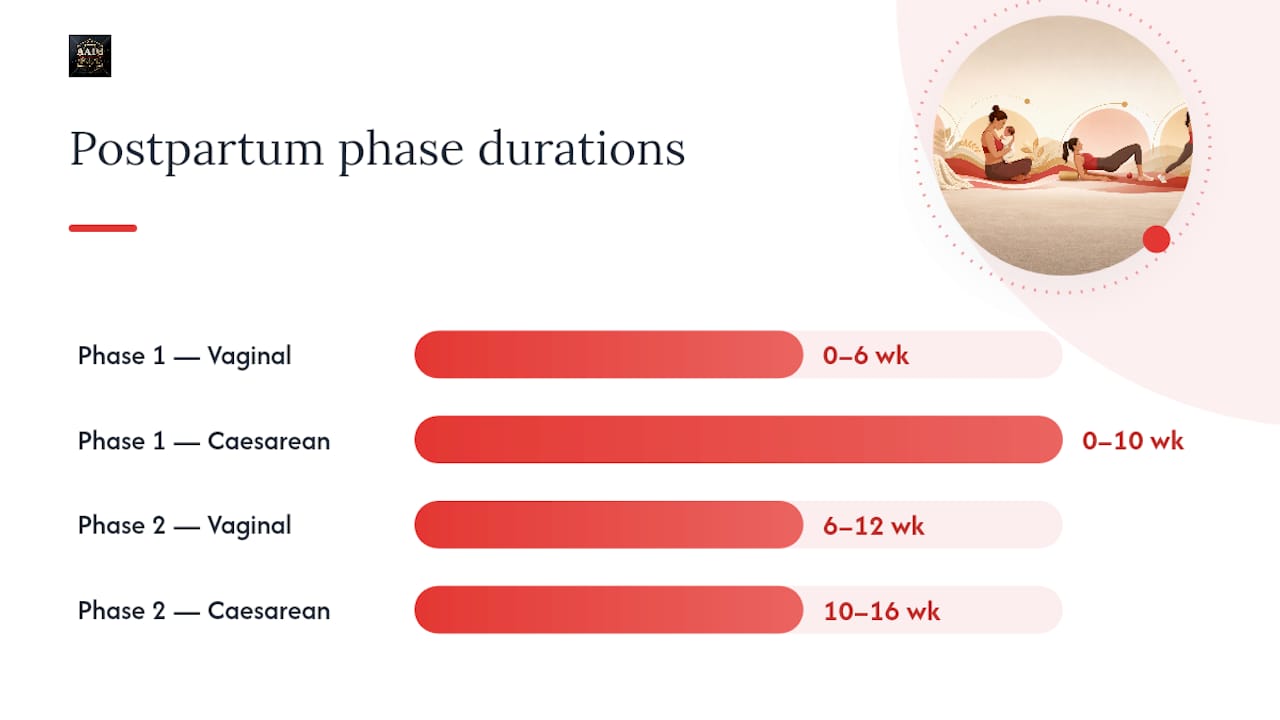
Phase 1: Reconnect (weeks 0 to 6 for vaginal birth, 0 to 10 for caesarean). The goal here is rebuilding the connection between your brain and your deep core and pelvic floor, not building strength. Daily priorities are diaphragmatic breathing, gentle pelvic tilts, short walks, and mobility work for the hips and upper back. Skip anything that increases intra-abdominal pressure.
Phase 2: Rebuild (weeks 6 to 12 for vaginal birth, 10 to 16 for caesarean). Once you have clearance and can perform basic core activation without strain, add light strength work: glute bridges, bird-dogs, modified planks, and low-impact cardio like brisk walking or a stationary bike. Three to four sessions a week of 20 to 30 minutes each is a realistic target. The safety marker at this stage is simple: your abdominal wall stays flat, or close to it, under load.
Phase 3: Return (12+ weeks for vaginal birth, 16+ weeks for caesarean). This is where you reintroduce heavier resistance training, running, or a return to a previous sport. Pelvic-floor care does not stop here. It becomes part of your warm-up permanently, since strength gains elsewhere can mask ongoing pelvic-floor weakness if you are not still training it directly.
Progression between phases should never be based on the calendar alone. Move forward when you consistently meet these markers:
- No coning or doming along your midline during exertion
- No new pelvic heaviness or dragging sensation after a session
- Leakage, if present, is minimal and not worsening
- You can complete your target reps without holding your breath or straining
Pro Tip: Keep a simple note on your phone after each session, just a tick or a cross for "any coning" and "any leaking". Patterns show up faster in writing than in memory, and that log is what tells you honestly whether you are ready to progress.
Functional markers like these matter more than a fixed timeline, because healing speed varies significantly between individuals depending on birth complexity, prior fitness, and how much rest you are actually getting.
A 4-week sample postpartum workout plan
This schedule assumes you already have medical clearance and are past the earliest days of recovery. If you are still in week one or two post-birth, stay with the gentle groundwork described below rather than skipping ahead.
- Week 1: Reconnect basics. Daily pelvic-floor micro-sessions (three sets of ten contractions), a 10 to 15-minute walk, and gentle pelvic tilts or cat-cow stretches. Rest whenever your body asks for it. This week is about consistency in small doses, not intensity.
- Week 2: Add light structure. Introduce two short strength sessions (15 minutes) featuring glute bridges, heel slides, and dead bugs, alongside daily walks extended to 20 minutes. Keep pelvic-floor micro-sessions running in the background.
- Week 3: Build session length. Push structured sessions to 20 to 30 minutes, three times a week, adding bird-dogs and side-lying clams. Introduce one low-impact cardio session, such as a longer walk or gentle cycling, if walking alone feels easy.
- Week 4: Full-body integration. Combine strength and light cardio into two or three full-body sessions of 25 to 35 minutes, plus one higher-volume day if energy allows. Pelvic-floor work continues daily, now folded into warm-ups rather than standing alone.
For days when a full session feels impossible, two 10-minute circuits, one in the morning and one in the evening, deliver nearly the same weekly volume without needing a block of uninterrupted time. Other practical adaptations include:
- Baby-next-to-you sessions: floor-based moves like pelvic tilts, glute bridges, and dead bugs work well on a mat beside a play mat or bouncer.
- Pram walks: a brisk push counts as cardio and doubles as settling time for a fussy baby.
- Feed-adjacent training: schedule strength work right after a feed, when you are less likely to be interrupted by hunger cues.
This structure mirrors the general shape used in most beginner strength progressions, just adapted for postpartum tissue healing and pelvic-floor priorities rather than raw strength gains.
Which core and pelvic-floor exercises are safe to start with?
Seven moves form the backbone of nearly every safe postpartum programme, and each one has a specific cue worth learning properly before you add reps.
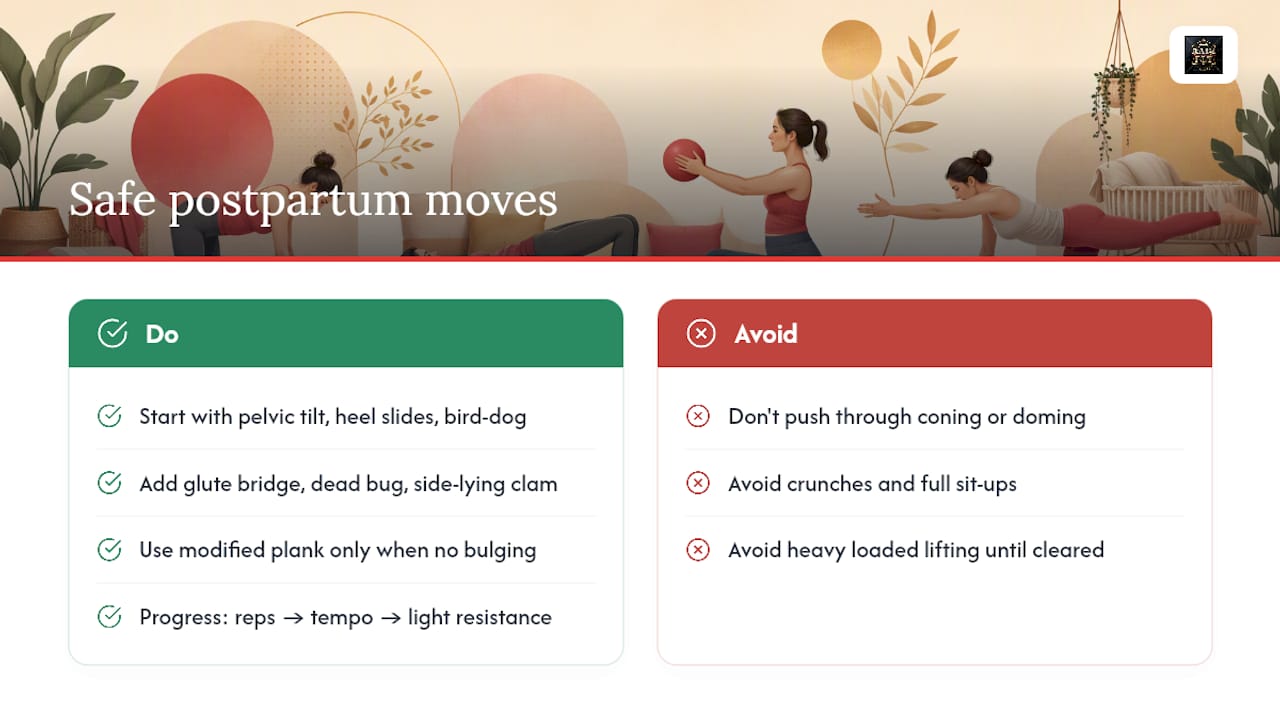
Pelvic tilt. Lie on your back, knees bent, and gently flatten your lower back into the floor by tilting your pelvis. Hold for 3 to 5 seconds. This reconnects you to your deep core without any real load.
Heel slides. From the same position, slide one heel away along the floor while keeping your pelvis still, then return. Stop immediately if your lower back arches or your belly bulges.
Bird-dog. On hands and knees, extend one arm and the opposite leg while keeping your spine neutral. This trains anti-rotation control, which is exactly what a healing core needs.
Glute bridge. Push through your heels to lift your hips, squeezing your glutes at the top. It strengthens the posterior chain without stressing the abdominal wall.
Dead bug. Lying on your back with arms and knees at 90 degrees, lower one arm and the opposite leg towards the floor while keeping your lower back pressed down. This is one of the best true diastasis-safe core exercises available.
Side-lying clam. Lying on your side with knees bent, lift the top knee while keeping feet together. This targets hip stability, which often weakens during pregnancy.
Modified plank. Start on knees rather than toes, and only progress once you can hold the position without any visible bulging along your midline.
Watch closely for coning or doming, a visible ridge running down your midline during exertion. Cleveland Clinic identifies coning as a clear signal that intra-abdominal pressure is too high for your current core control, and the correct response is to stop and regress immediately, not push through.
Pro Tip: If a move causes coning, don't abandon it entirely. Reduce the range of motion, slow the tempo, or switch to a pure isometric hold instead. That small adjustment is often the difference between "not ready yet" and "ready in two weeks".
Progress by adding reps first, then tempo, then light resistance, in that order. Hold off on crunches, full sit-ups, and heavy loaded lifting until you have clearance and can move through the exercises above without any coning.
How do you check for diastasis recti and train around it?
Diastasis recti is a separation of the abdominal muscles along the midline, and it is present to some degree in most pregnancies. Checking for it is straightforward: lie on your back with knees bent, lift your head and shoulders slightly off the floor, and feel along your midline above and below your belly button. A gap wider than two to three finger-widths, especially with visible doming, suggests diastasis worth addressing deliberately.
Cleveland Clinic is explicit that standard abdominal exercises such as crunches, sit-ups, and double-leg lifts can worsen diastasis recti rather than heal it, because they increase pressure on an already-weakened midline. Safe recovery instead relies on deep-core engagement: diaphragmatic breathing, pelvic tilts, bird-dogs, and glute bridges, all of which strengthen the transverse abdominis without straining the linea alba.
Pelvic-floor training runs alongside this work. A basic Kegel involves contracting the muscles you would use to stop a stream of urine, holding for a few seconds, then fully releasing. Frequency matters more than intensity: three sets of ten contractions spread through the day tends to build the habit far more reliably than one long session, according to Mayo Clinic's postpartum guidance. Avoid bearing down or straining during any exercise, since that works directly against pelvic-floor recovery.
Seek specialist referral, typically to a pelvic-health physiotherapist, if you notice persistent bulging that does not improve after several weeks of gentle core work, ongoing pelvic heaviness, or urinary or bowel symptoms that interfere with daily life.
How should you structure each session and track progress?
A workable postpartum session follows the same basic shape every time: warm up for five minutes with gentle mobility and breathing, spend ten minutes on core and pelvic-floor work, add a strength or cardio block suited to your current phase, then finish with a short cool-down and stretch.
- Warm-up (5 minutes): diaphragmatic breathing, hip circles, gentle cat-cow.
- Core and pelvic-floor block (10 minutes): pelvic tilts, dead bugs, Kegels.
- Strength or cardio block (10 to 20 minutes, phase-dependent): glute bridges, bird-dogs, walking, or light resistance band work.
- Cool-down (5 minutes): gentle stretching, breathing to reset your nervous system.
Splitting this into three 10-minute blocks across the day works just as well as one continuous session if that is all your schedule allows. A resistance band and a single pair of light dumbbells cover most of what Phase 2 and Phase 3 need, and both pack into a nappy bag easily enough to train while your baby naps in the pram.
Pro Tip: Track three numbers each week: reps completed without coning, whether leakage happened during exercise, and the length of your longest walk. Those three markers tell you more about real progress than the bathroom scale ever will.
Why trust this postpartum workout plan?
This postpartum programming follows a phase-based logic similar to clinical guidance from ACOG and Mayo Clinic, matching exercise progression to healing timelines rather than generic week counts. The platform's women system postpartum module applies this through 35 research-backed tools that adjust as you log symptoms and performance, including real-time form correction that flags compensations a mirror alone would miss.
Two practical starting points if you want personalisation beyond this article's template:
- Run the free workout generator to build a session around your current phase and available time
- Use the postpartum module to log symptoms and let progressions adjust automatically
None of this replaces an individual assessment. If you have specific concerns about diastasis severity, pelvic organ prolapse, or ongoing pain, a coach review or pelvic-health physiotherapist referral should come before any structured programme.
What new mothers get wrong about postpartum exercise
Most advice aimed at new mothers either overcorrects into extreme caution, treating the entire fourth trimester as a write-off, or swings the other way and pushes "bounce back" timelines that ignore what tissue actually needs to heal. Neither serves you well. The evidence supports something more useful: gentle activity from very early on, paired with real attention to symptoms rather than a countdown clock.
The biggest gap I see in conventional advice is the missing middle step. Plenty of guidance tells you to "listen to your body" without explaining what that actually means in practice. Coning is not vague intuition. It is a visible, checkable sign. Leakage during a set is not something to laugh off as normal and permanent. It is direct feedback that a movement needs to be regressed today, not endured for months.
If you take one thing from this, prioritise the boring stuff first: breathing, pelvic tilts, and short walks, tracked honestly, before you chase a return to your old training split. Recovery that respects sequence tends to be faster than recovery that skips it.
— Aditya
Get a postpartum plan built around your own recovery data
A generic PDF plan cannot see whether you coned on your third dead bug or how your leakage changed after two weeks of consistent pelvic-floor work. Aadifit is built to track exactly that, adjusting your postpartum programme week by week based on what you log rather than a fixed script everyone follows regardless of how their body is actually healing.
Start with the free fitness assessment to identify where your recovery currently stands, then explore the Explorer, Performer, and Elite plans for ongoing coaching, with Performer priced at ₹1,499 per month and Elite at ₹3,999 per month. If you want direct one-on-one coach access through your recovery, the Personal plan at ₹6,000 per month pairs a real coach with the same data-driven progressions. Take the assessment today and see what your first phase-appropriate session should actually look like.
This article is general information, not a substitute for advice from a qualified doctor. Consult a qualified healthcare professional about your own circumstances before acting on anything here.
Sources
- Diastasis recti — Cleveland Clinic
- Exercise after pregnancy — ACOG
- Exercise after pregnancy — Mayo Clinic
FAQ
How soon can I work out after giving birth?
Gentle walking and pelvic-floor exercises can often start within days of an uncomplicated vaginal birth, while structured training after a caesarean should wait for medical clearance, typically around six to eight weeks. Always confirm timing with your GP or midwife, since healing speed varies between individuals.
What is the 5-5-5 rule for postpartum recovery?
The 5-5-5 rule is an informal guideline some sources use, suggesting five days of rest indoors, five days of gentle movement around the home, and five days of short outdoor walks before progressing further. It is not a clinical standard from ACOG or Mayo Clinic, so treat it as a loose framework rather than a fixed prescription, and prioritise symptom-based progression instead.
What is a good workout routine for a postpartum mum?
A good routine follows the phased approach: pelvic-floor and breathing work first, then light strength moves like glute bridges and bird-dogs, then a gradual return to full training once you show no coning, minimal leakage, and comfortable movement. Aadifit's postpartum module structures exactly this progression using logged symptoms and performance data.
What is the 3-3-3 rule for working out?
Definitions of the 3-3-3 rule vary depending on the source, and it is not a term used in the clinical guidance behind this article, so no single canonical postpartum version exists. If you have seen it applied to your routine, check the original source's exact definition rather than assuming a fixed meaning.
How much does personalised postpartum coaching cost?
Aadifit's Performer plan costs ₹1,499 per month, and the Elite plan costs ₹3,999 per month, both offering adaptive coaching plans. For direct one-on-one coach access, the Personal plan is priced at ₹6,000 per month.